

سُبْحَانَ الَّذِي سَخَّرَ لَنَا هَذَا وَمَا كُنَّا لَهُ مُقْرِنِينَ، وَإِنَّا إِلَى رَبِّنَا لَمُنْقَلِبُونَ
It is always beneficial to say duas before setting off on a journey. However, you are still learning Arabic and therefore can’t properly read duas written in Arabic. That is where the travel duas with transliteration come in. Here, you can learn to pronounce the Arabic sounds by using the English alphabet. Along with the transliteration, this dua also explains how the Arabic sounds are produced and helps the readers progress from reading letters to memorising the dua.
What Is Travel Dua Transliteration?
رَبِّ يَسِّرْ وَلَا تُعَسِّرْ
Transliteration is writing the sounds of a particular language by using the alphabet of another language. In this case, the sounds of Arabic are written using the English alphabet.
Transliteration of Arabic doesn’t give the meanings of words. For beginners, this method is very helpful for pronouncing Arabic sounds. The travel dua transliteration is very beneficial for people who want to learn the dua that the Prophet Muhammad (PBUH) used to read for travellers. Use this method to learn the travel dua and try to read the Arabic script dua on your own.
Travel Dua Transliteration: The Full Text, Line by Line
اللَّهُ أَكْبَرُ، اللَّهُ أَكْبَرُ، اللَّهُ أَكْبَرُ
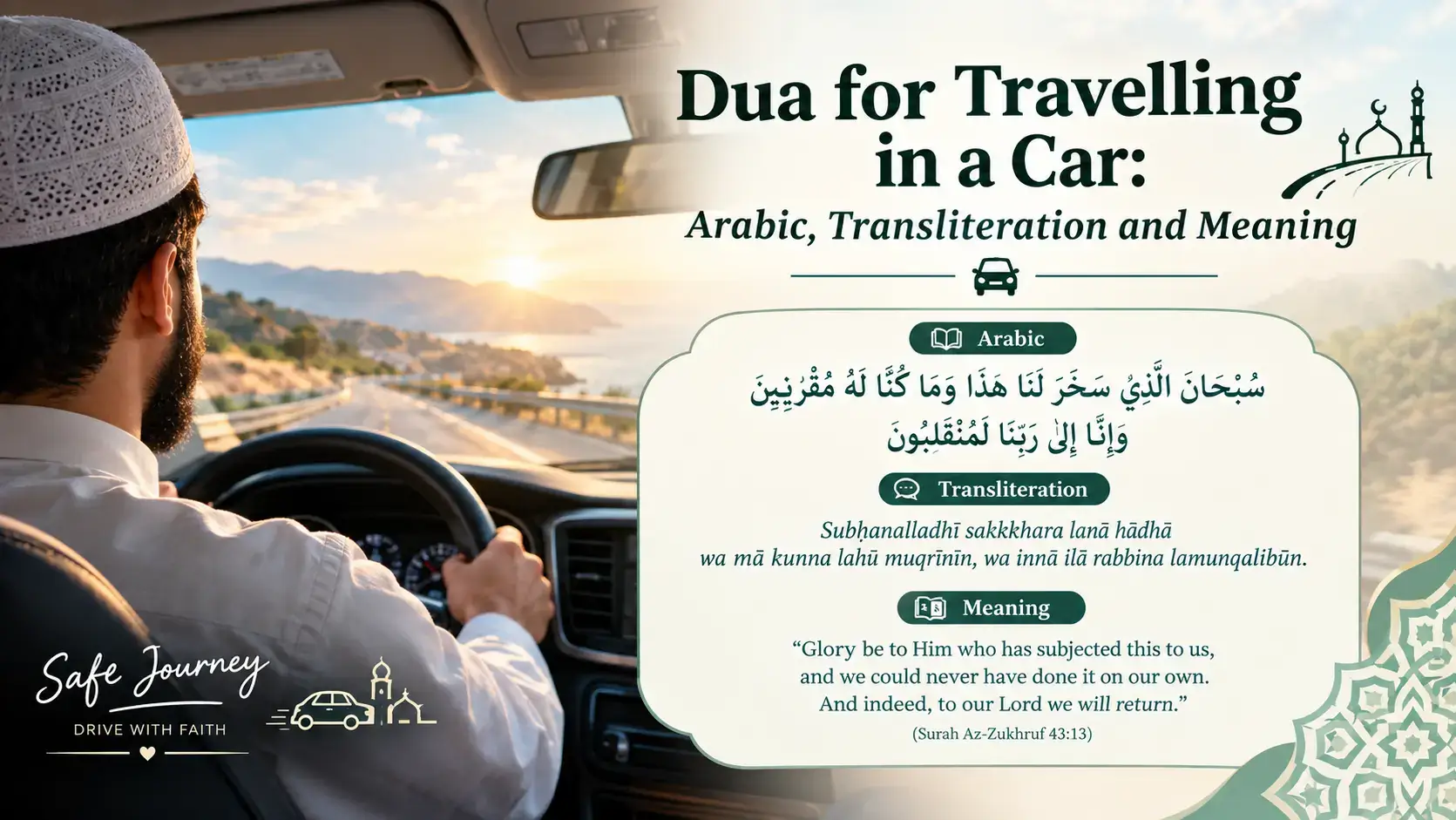
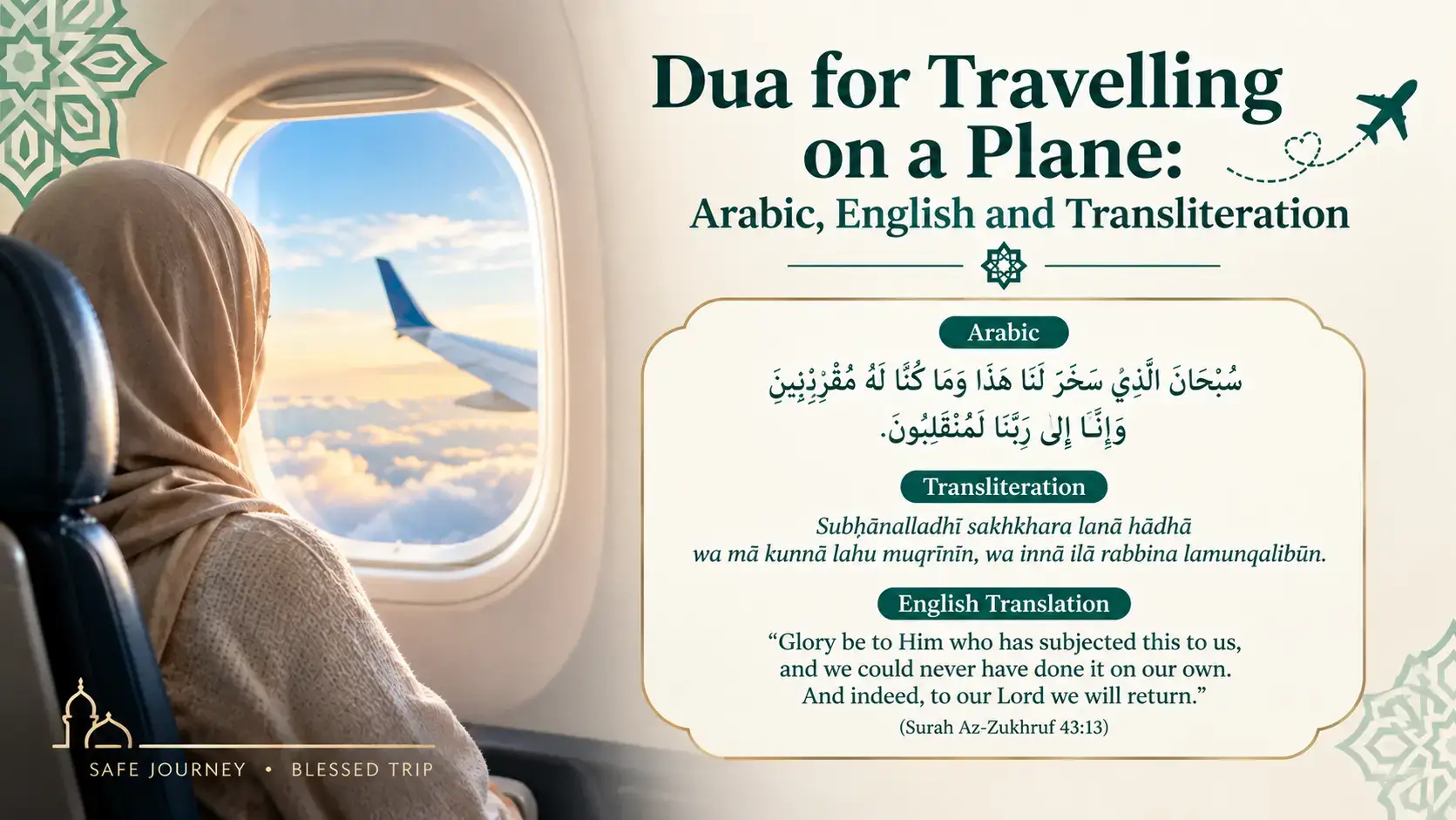
سُبْحَانَ الَّذِي سَخَّرَ لَنَا هَذَا وَمَا كُنَّا لَهُ مُقْرِنِينَ، وَإِنَّا إِلَى رَبِّنَا لَمُنْقَلِبُونَ
Here is the full travel dua transliteration, split into short lines with the Arabic beside each:
| Arabic | Transliteration |
| اللَّهُ أَكْبَرُ (×3) | Allahu Akbar |
| سُبْحَانَ الَّذِي سَخَّرَ لَنَا هَذَا وَمَا كُنَّا لَهُ مُقْرِنِينَ | Subhanal-ladhi sakhkhara lana hadha wa ma kunna lahu muqrinin |
| وَإِنَّا إِلَى رَبِّنَا لَمُنْقَلِبُونَ | Wa inna ila Rabbina lamunqalibun |
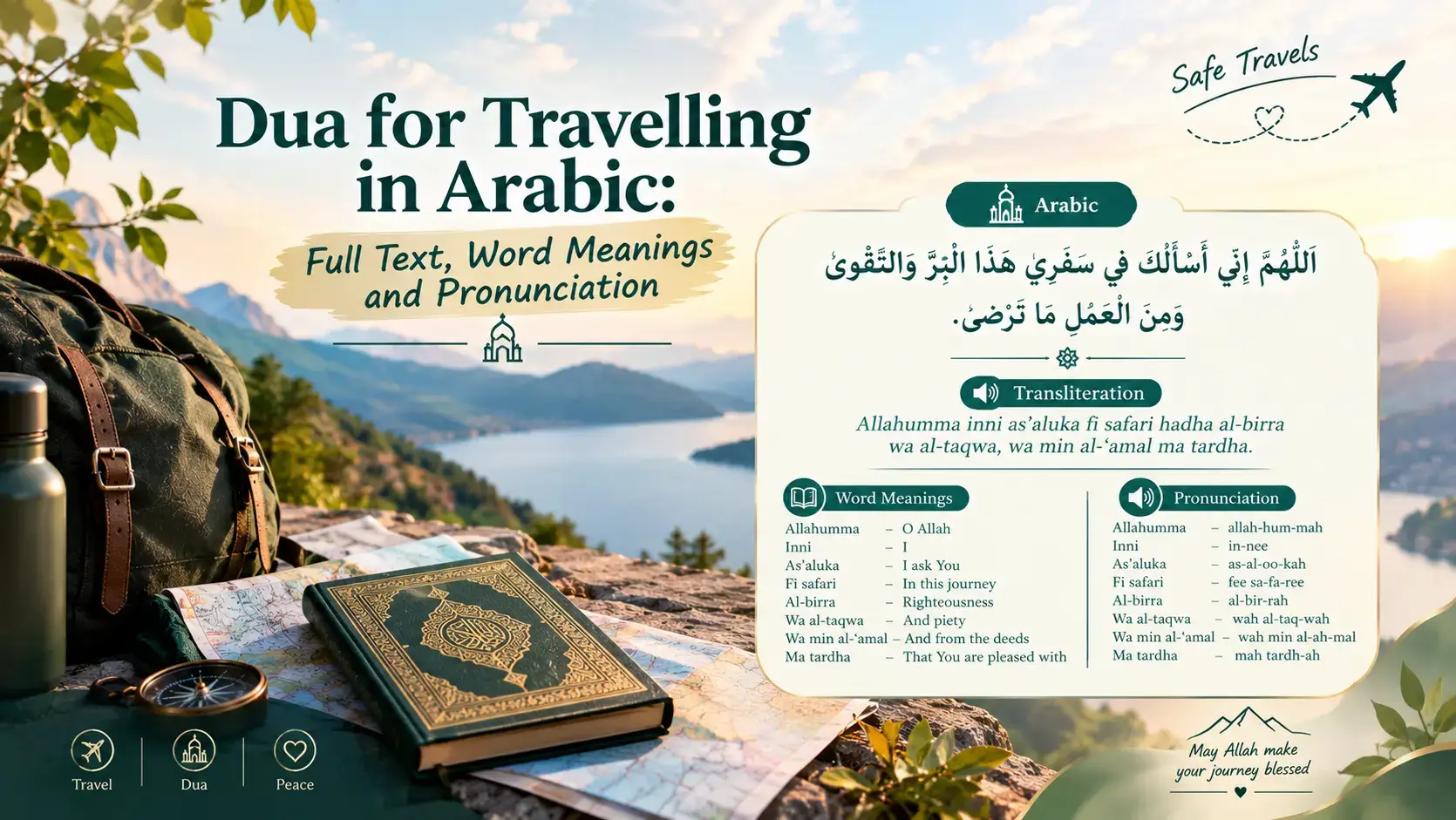
| اللَّهُمَّ إِنَّا نَسْأَلُكَ فِي سَفَرِنَا هَذَا الْبِرَّ وَالتَّقْوَى | Allahumma inna nas’aluka fi safarina hadhal-birra wat-taqwa |
| وَمِنَ الْعَمَلِ مَا تَرْضَى | Wa minal-‘amali ma tarda |
| اللَّهُمَّ هَوِّنْ عَلَيْنَا سَفَرَنَا هَذَا وَاطْوِ عَنَّا بُعْدَهُ | Allahumma hawwin ‘alayna safarana hadha watwi ‘anna bu’dah |
| اللَّهُمَّ أَنْتَ الصَّاحِبُ فِي السَّفَرِ، وَالْخَلِيفَةُ فِي الأَهْلِ | Allahumma antas-sahibu fis-safar, wal-khalifatu fil-ahl |
| اللَّهُمَّ إِنِّي أَعُوذُ بِكَ مِنْ وَعْثَاءِ السَّفَرِ، وَكَآبَةِ الْمَنْظَرِ، وَسُوءِ الْمُنْقَلَبِ فِي الْمَالِ وَالأَهْلِ | Allahumma inni a’udhu bika min wa’tha’is-safar, wa ka’abatil-manzar, wa su’il-munqalabi fil-mali wal-ahl |
Dua for Travelling Transliteration: How to Read the Symbols
رَبِّ زِدْنِي عِلْمًا
People who search for travel duas get confused by the use of various spellings, apostrophes, and doubling of letters. The purpose of this writing is to answer these questions.
- dh is a soft “th” as in “this”.
- kh is a rough sound from the throat, like the “ch” in Scottish “loch”.
- ‘ (apostrophe) marks either a brief pause (hamzah) or the throaty letter ayn, as in ‘alayna.
- Doubled letters (like kk or ll) are held a little longer. In sakhkhara and hawwin, linger on the middle sound.
- Hyphens show where a word joins the next, such as Subhanal-ladhi or wat-taqwa.
- a, i, u are short vowels, while aa, ee, oo (or ā, ī, ū) are held for two counts.
Dua for Travel Transliteration: Pronunciation Tips for Hard Sounds
رَبِّ اشْرَحْ لِي صَدْرِي وَيَسِّرْ لِي أَمْرِي
Rabbi ishrah li sadri wa yassir li amri. (“My Lord, expand my chest and make my task easy for me.”)
Many people are also interested in knowing how to write travel duas in the English alphabet. A phonetic notation is given here.
- The letter ص in as-sahibu: pronounce it as a deep, full “s”, not a thin one.
- The letter ط in watwi: a heavy “t” with the tongue pressed firmly against the roof of the mouth.
- The letter ق in taqwa and lamunqalibun: it comes from the back of the throat, not like an English “k”.
- The letter ع in ‘alayna and wa’tha’: a sound from the throat, not a plain “a”.
- The letter ح in Subhana: a soft, breathy “h” from the throat.
Listen to a reliable reciter once, then repeat one phrase at a time. A teacher of tajweed can correct what a page cannot.
Travel Dua English Transliteration: Words You Will Recognise
سُبْحَانَ اللَّهِ وَبِحَمْدِهِ
Many readers search for ‘travel dua’ in English transliteration because they want a version in plain English letters without special symbols. If that is you, this simplified version is easier on the eye:
Allahu Akbar (3 times)
Subhaanal-lazee sakh-khara lanaa haazaa wa maa kunnaa lahoo muqrineen, wa innaa ilaa Rabbinaa la-munqaliboon.
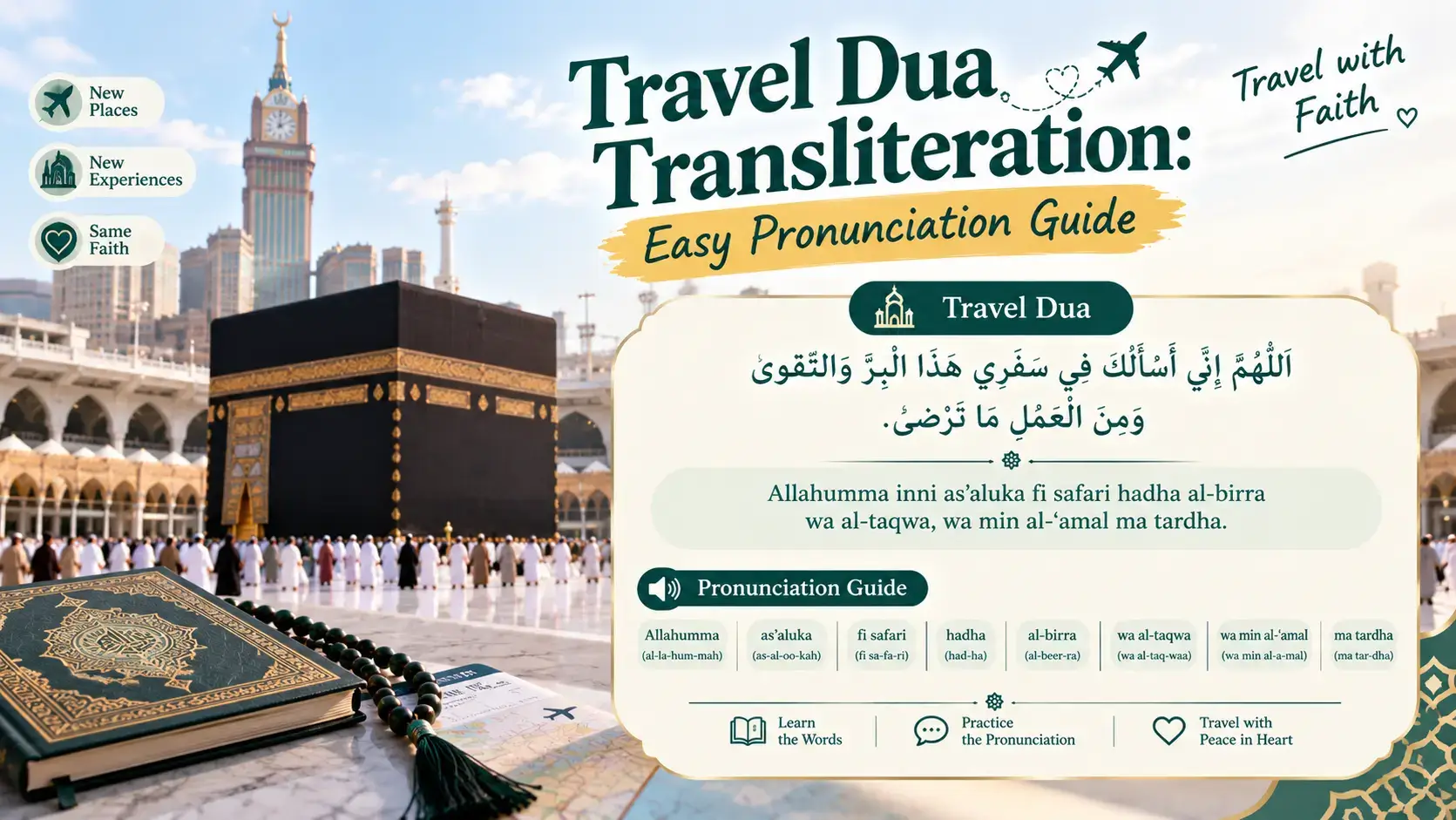
Allaahumma innaa nas-alukaa fee safarinaa haazal-birra wat-taqwaa, wa minal-amali maa tardaa.
Allaahumma hawwin alaynaa safaranaa haazaa waty-wi annaa bu-dah.
Allaahumma antas-saahibu fis-safar, wal-khaleefatu fil-ahl.
Allaahumma innee aoozu bika min waa-saa-is-safar, wa kaabatil-manzar, wa soo-il-munqalabi fil-maali wal-ahl.
Notice that long vowels are written with doubled letters (aa, ee, oo) and syllables are split with hyphens. Different websites spell things differently, so do not worry if you see slight variations. The sounds are what matter.
Travelling Dua Transliteration for the Journey Itself
بِسْمِ اللَّهِ، تَوَكَّلْتُ عَلَى اللَّهِ، وَلَا حَوْلَ وَلَا قُوَّةَ إِلَّا بِاللَّهِ
Bismillah, tawakkaltu ‘alallah, wa la hawla wa la quwwata illa billah.
This dua works at all stages. It is recommended to say this dua starting from your front door as “Bismillah, Allahumma amanat Bi raiha, La Haula wa La Quwata illa Bi rahman Allah” (it means, I am proceeding towards my destination with the support and protection of Allah). It is mentioned in the Sahih hadith of Abu Dawud and At Tirmidhi that Allah grants His travellers protection and security and also guides them. So, recite the dua at your desired destination. Similarly, this is applicable to all modes of transport.
Meaning of the Transliterated Words
وَإِنَّا إِلَى رَبِّنَا لَمُنْقَلِبُونَ
After learning and remembering this travel dua, one may understand the benefits of reading travel duas. Given here is the translation of the travel dua.
- Subhanal-ladhi sakhkhara lana hadha: Glory be to Him who made this vehicle usable for us.
- Wa ma kunna lahu muqrinin: We could never have mastered it ourselves.
- Wa inna ila Rabbina lamunqalibun: And to our Lord we will surely return.
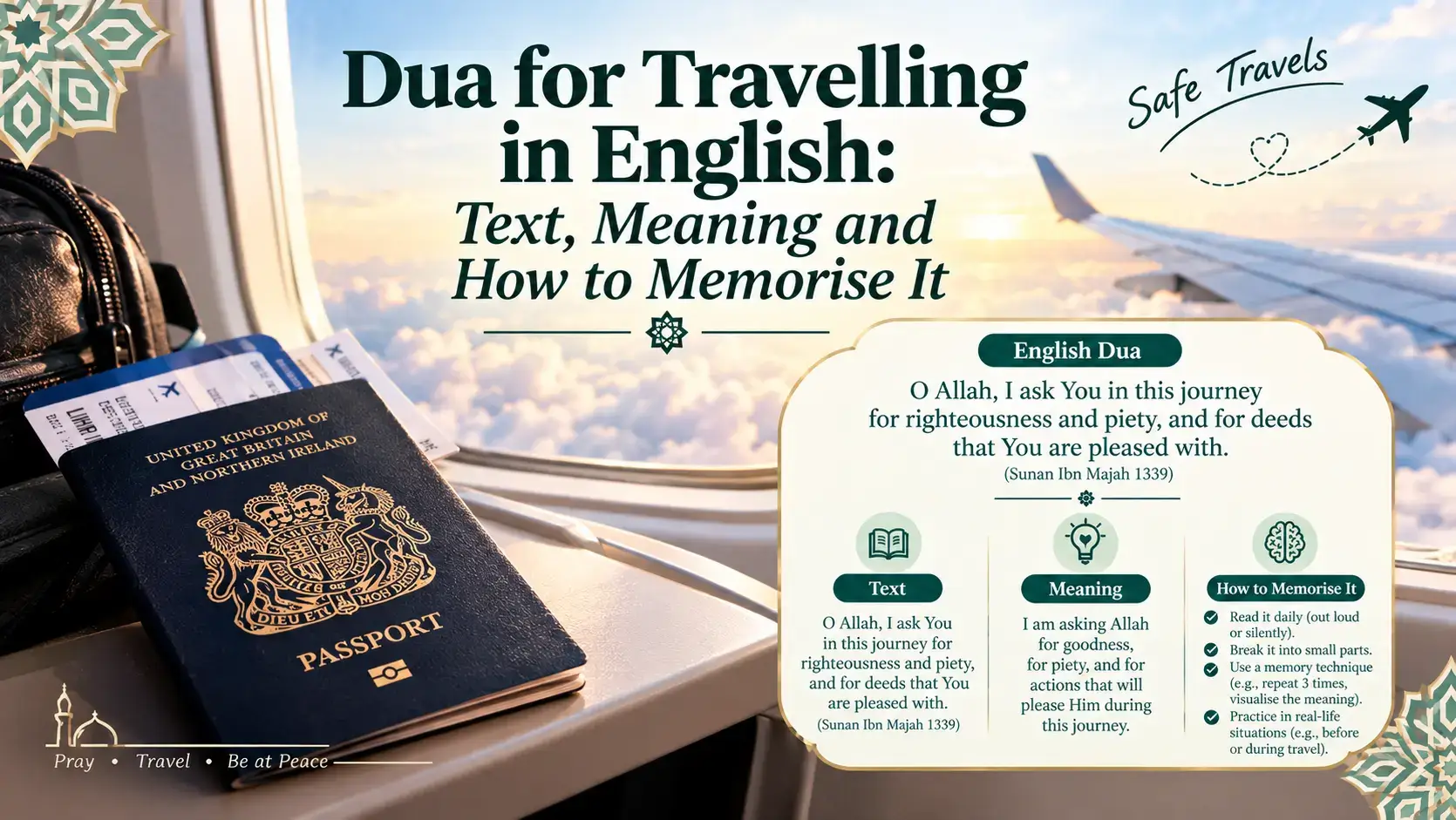
- Nas’aluka al-birra wat-taqwa: We ask You for goodness and piety.
- Hawwin ‘alayna safarana: Make our journey easy.
- Watwi ‘anna bu’dah: Shorten its distance for us.
- Antas-sahibu fis-safar: You are the Companion on the road.
- Wal-khalifatu fil-ahl: And the guardian of the family we left behind.
- A’udhu bika: I seek refuge in You from hardship, sorrow and a bad outcome.
A Simple Plan to Learn the Transliteration in Three Days
رَبَّنَا آتِنَا فِي الدُّنْيَا حَسَنَةً وَفِي الْآخِرَةِ حَسَنَةً وَقِنَا عَذَابَ النَّارِ
- Day 1: Read the opening line (Subhanal-ladhi…) ten times, slowly, listening to a reciter first.
- Day 2: Add the lines beginning ‘Allahumma inna nas’aluka…‘ and ‘Allahumma hawwin…’
- Day 3: Add the last two lines about the companion and refuge, then recite everything together.
After three days, try reading the Arabic text next to the transliteration. Over time, let your eyes move from the English letters to the Arabic script. Children can follow the same plan, one line a day.
Dua on Returning Home: Transliteration
آيِبُونَ تَائِبُونَ عَابِدُونَ لِرَبِّنَا حَامِدُونَ
Ayibuna ta’ibuna ‘abiduna li-Rabbina hamidun. (“We return, repenting, worshipping and praising our Lord.”)
It is recommended to practise reading the travel dua every day. Travel duas have been taught by the Prophet Muhammad (PBUH) to be repeated upon his return by all the members of the travel party.
Conclusion
اللَّهُمَّ إِنَّا نَسْأَلُكَ فِي سَفَرِنَا هَذَا الْبِرَّ وَالتَّقْوَى، وَمِنَ الْعَمَلِ مَا تَرْضَى
It is now possible for every Muslim to recite the words of the Prophet (SAW) with regard to travel. As with anything new, start with the English translation, then move to the Arabic text. It is our request and prayer to the Most Beneficent (SWT) to ease and safeguard our journeys and to grant us His Mercy. Ameen.
Frequently Asked Questions
رَبَّنَا تَقَبَّلْ مِنَّا إِنَّكَ أَنتَ السَّمِيعُ الْعَلِيمُ
Can I use a transliteration to recite this dua?
Yes. Since a person is able to pronounce a dua in any form, they are able to gain reward for doing so. Of course, using Arabic is preferred.
Why does a variation occur in different websites’ spellings?
There is no uniformity with regard to spellings.
Is there a variation in the transliteration for different means of transportation?
No, the same dua is used for all means of transportation.
What happens if I pronounce a word incorrectly?
Practice with a good model. Depending on your effort, Allah (SWT) will reward you.