

There are numerous decisions to be made in life: what job offer should I take? Who should I marry? Should I move to a new city? When the answer isn’t clear, the practice of Islam gives us salat ul isthikhara, which is a prayer that helps us get a solution from Allah.
We will explain what istikhara is, the procedure of how to do it, the dua with its meaning in English, and common misunderstandings and misconceptions that the majority of people have.
What Is Salatul Istikhara?
The word “istikhara” comes from the Arabic root “khayr”, meaning “good”. Istikhara literally means ‘seeking the best‘ or ‘asking Allah to guide you toward what is good’.
Istikhara is a method of figuring something out for yourself and then praying to Allah for his decision and wisdom to see things that are beyond you. It is like saying, “O Allah, I’ve thought things through and done my research, but You know things that I don’t. Please guide me.”
Sahih al-Bukhari narrates that the Prophet of Islam ﷺ taught the practice of Istikhara to his companions just as he did with the chapters of the Quran, showing how this practice is beneficial and important.
When Should You Pray Istikhara?
Istikhara applies to permissible things, like:
- Choosing a spouse and getting married
- Job choices
- Starting a business or investing
- Relocating
- Field of study
- Buying or selling something of major value
- Travelling
You do not pray Istikhara for obligatory acts (like Hajj when you’re able, or daily prayers) or for forbidden acts (a sinful act is simply avoided). It’s also not needed for trivial everyday matters.
How to Perform Salatul Istikhara: Step by Step
- Make wudu (ablution) and ensure you are in a clean state.
- Choose a suitable time. Any time when voluntary prayer is permitted is a good time. Many people prefer the last third of the night, a time when duas are especially accepted.
- Make the intention (niyyah) in your heart to pray two rakats of istikhara and do not express it verbally.
- Pray two rakats of voluntary (nafl) prayer. In the first rakat, many scholars suggest that after Surah Al-Fatiha, one recites Surah Al-Kafirun, and in the second rakat, one recites Surah Al-Ikhlas, but it is valid to recite any surah of one’s choice.
- After the salam, recite the Istikhara dua. and begin by sending salawat upon the Prophet ﷺ and praising Allah.
- Once you finish sending salawat and praising Allah, express in the dua your need/question and mention it as “this matter”. For example, for “this job” or “this marriage”.
- Ask Allah sincerely.
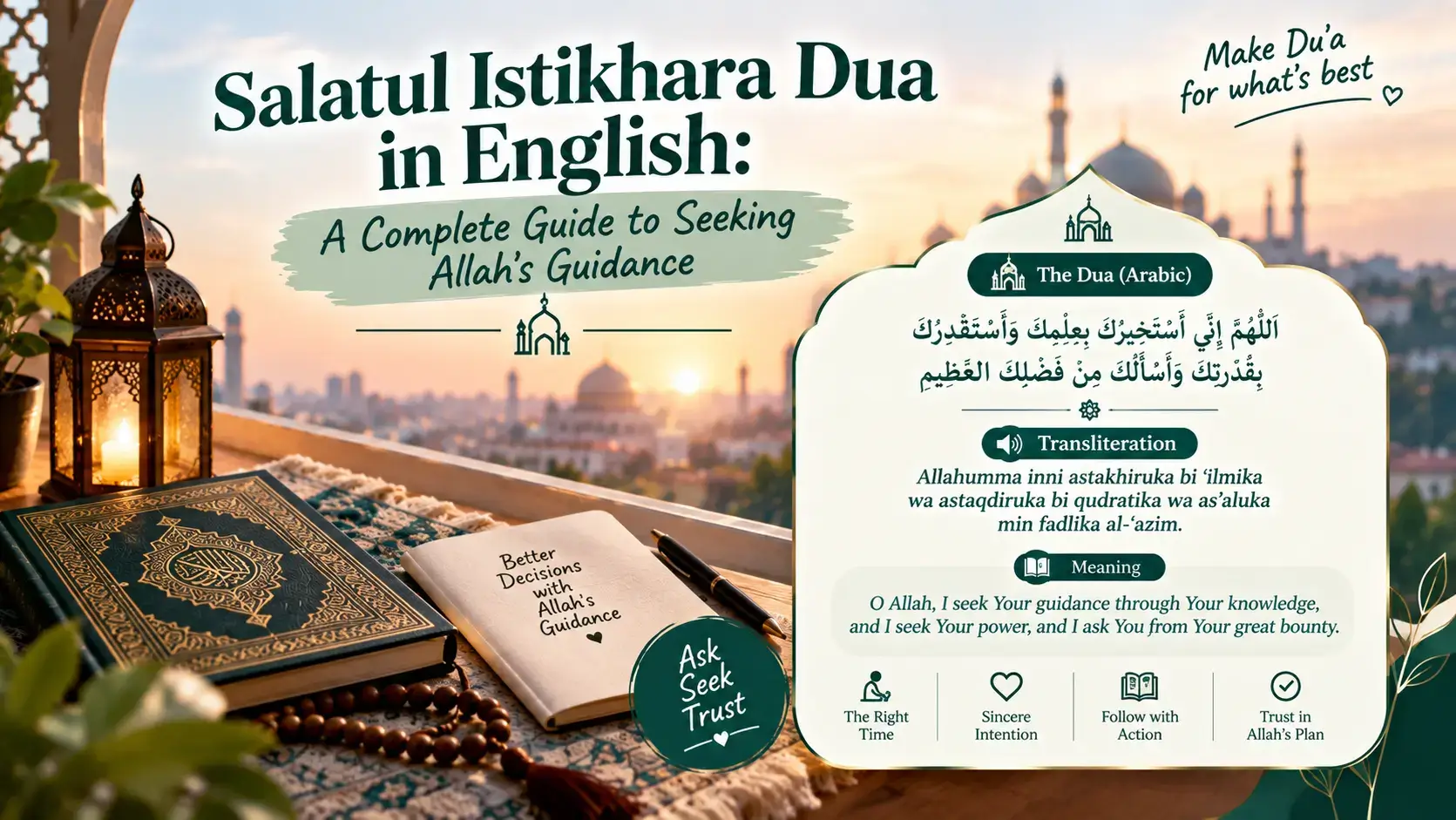
The Istikhara Dua in Arabic
اللَّهُمَّ إِنِّي أَسْتَخِيرُكَ بِعِلْمِكَ، وَأَسْتَقْدِرُكَ بِقُدْرَتِكَ، وَأَسْأَلُكَ مِنْ فَضْلِكَ الْعَظِيمِ، فَإِنَّكَ تَقْدِرُ وَلَا أَقْدِرُ، وَتَعْلَمُ وَلَا أَعْلَمُ، وَأَنْتَ عَلَّامُ الْغُيُوبِ
اللَّهُمَّ إِنْ كُنْتَ تَعْلَمُ أَنَّ هَذَا الْأَمْرَ خَيْرٌ لِي فِي دِينِي وَمَعَاشِي وَعَاقِبَةِ أَمْرِي، فَاقْدُرْهُ لِي وَيَسِّرْهُ لِي ثُمَّ بَارِكْ لِي فِيهِ
وَإِنْ كُنْتَ تَعْلَمُ أَنَّ هَذَا الْأَمْرَ شَرٌّ لِي فِي دِينِي وَمَعَاشِي وَعَاقِبَةِ أَمْرِي، فَاصْرِفْهُ عَنِّي وَاصْرِفْنِي عَنْهُ، وَاقْدُرْ لِيَ الْخَيْرَ حَيْثُ كَانَ ثُمَّ أَرْضِنِي بِهِ
Transliteration
Allahumma inni astakhiruka bi-ilmika, wa astaqdiruka bi-qudratika, wa as’aluka min fadlikal-azeem, fa innaka taqdiru wa la aqdir, wa ta’lamu wa la a’lam, wa anta allamul-ghuyub.
Allahumma in kunta ta’lamu anna hadhal-amra khayrun li fi deeni wa ma’ashi wa ‘aqibati amri, faqdurhu li wa yassirhu li thumma barik li fihi.
Wa in kunta ta’lamu anna hadhal-amra sharrun li fi deeni wa ma’ashi wa ‘aqibati amri, fasrifhu ‘anni wasrifni ‘anhu, waqdur liyal-khayra haythu kana thumma ardini bih.
Salatul Istikhara Dua in English
“O Allah, I seek Your guidance by virtue of Your knowledge, and I seek ability by virtue of Your power, and I ask You of Your great bounty. You have power; I have none. And you know, I know not. You are the Knower of hidden things.
O Allah, if in Your knowledge this matter [name your matter] is good for my religion, my livelihood, and my affairs, both present and future, then ordain it for me, make it easy for me, and bless it for me.
And if, in Your knowledge, this matter is bad for my religion, my livelihood, and my affairs, both present and future, then turn it away from me and turn me away from it, and ordain for me the good wherever it may be, and make me pleased with it.”
Understanding the Meaning of the Dua
This supplication is a masterpiece of humility and trust. Let’s look at its three parts:
- Admitting we do not have knowledge of what is good for us, and we may be lost and confused. Therefore, we seek Allah’s help and guidance in the things that are good for our Iman, Rozi (livelihood) and Aakhirat (everything that has passed, is passing and will pass).
- Asking for protection from that which is bad for us. We seek Allah’s protection to turn that which is bad away from us and to make us content with that decision.
Common Misconceptions About Istikhara
Myth 1: You will always see a dream.
Some people believe that if they pray istikhara but don’t see a dream, they should pray it again. Dreams, however, are not a necessary component of istikhara. Guidance can come through a number of other means, such as ease/difficulty, changing heart conditions, the way things turn out, or the environment around you.
Myth 2: Istikhara is only for marriage
Istikhara is for any important Islamic decision in your life.
Myth 3: Someone else can pray it for you.
Seeking guidance through istikhara is an individual duty and responsibility. It is always better to pray it yourself, but you can always consult learned and trusted people through istishara (seeking other people’s advice).
Myth 4: You interpret the colours, white or black, to get the answer.
There is absolutely no basis for colour interpretation of istikhara. If someone is charging you to interpret istikhara for you, beware.
Myth 5: You can pray it once and never have to pray it again.
You can pray it as many times as you want if you’re still confused.
How Do You Know the Answer?
Scholars say that when you pray itikhara, you get the answer:
- Allah makes things easier for you, and your heart gets at peace.
- If something is difficult for you, or there are obstacles, or your heart turns away from it, that is also a kind of guidance.
- You don’t have to rely only on your feelings. You can use your reason and consult people and do research, etc.
- Trust the outcome and remember the last part of the istikhara: asking Allah to make you satisfied with His decision.
Tips for Making Your Istikhara More Meaningful
- Don’t go into Istikhara with a cluttered mind. It’s set on a specific outcome already. Go with an open heart.
- Consult before and after. Seek the counsel of virtuous and wise individuals who know your case.
- Keep up dua. Add what you will to your supplications.
- Boost your relationship with Allah by not sinning, praying, and doing charity.
- Gracefully accept the answer. Just because it’s a no doesn’t mean it isn’t for the best.
Final Thoughts
Istikhara is an act of worship. By its nature, it reflects humility and trust in Allah. We must also be humble and have tawakkul (trust in Allah). We do our part with Istikhara by thinking, researching and consulting, but hand the rest over to Allah, who knows the unseen.
The best part about Istikhara is this: whatever the outcome, we can rest assured that we’ve handed it to Allah and can keep on moving, knowing that the best decision was made.
May Allah guide us all to what is best and most blessed in this life and the next. Ameen.
Frequently Asked Questions (FAQs)
Can women pray Istikhara during their menstrual cycle?
The prayer itself cannot be performed during menstruation. However, scholars say that she may recite the Istikhara dua without the prayer.
Can I make the dua in my own language?
Arabic is preferred, as it’s the wording taught by the Prophet ﷺ. If someone cannot memorise it, they may recite it in their own language while understanding its meaning.
How many days should I pray Istikhara?
There’s no fixed number. Some scholars suggest repeating it seven times or over several days if you remain unsure, but there’s no authentic requirement.
Should I pray Istikhara before or after consulting people?
Both are encouraged. Consultation and Istikhara complement each other.